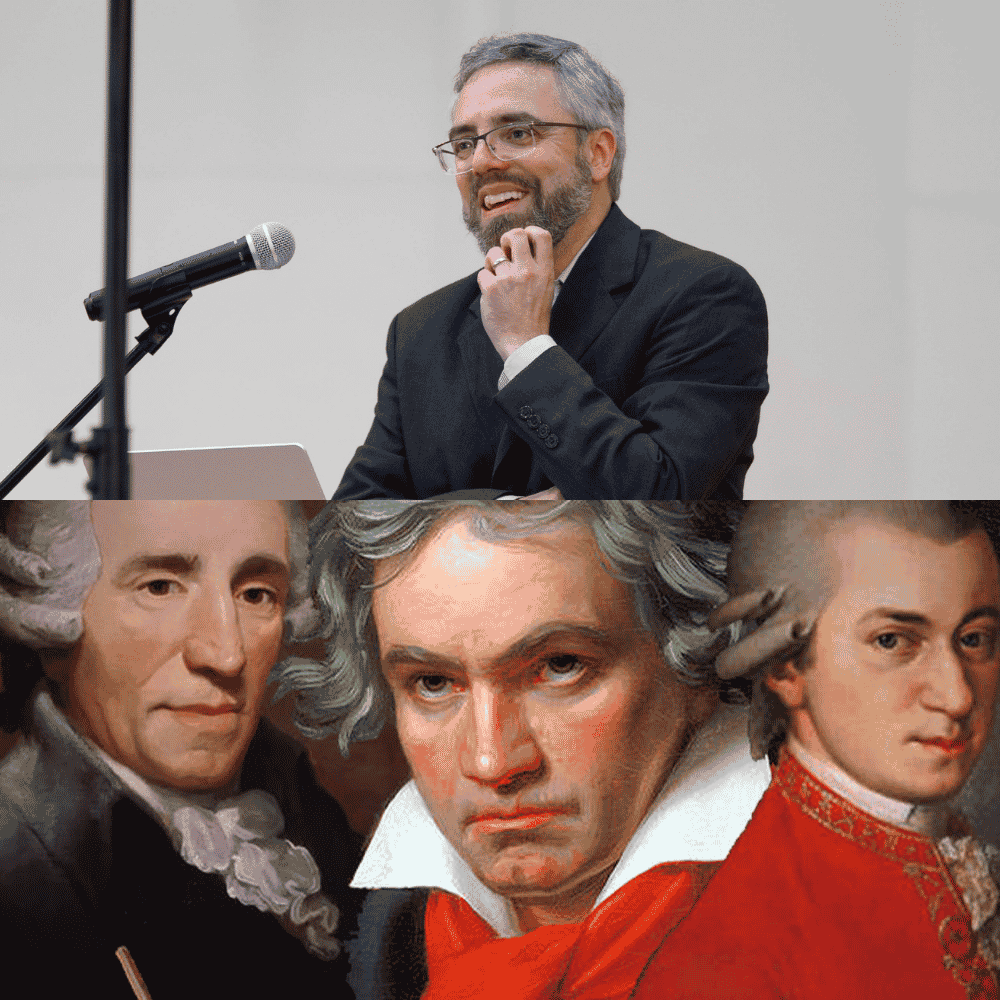

Paul Berry is Deputy Dean and Associate Professor (Adjunct) of Music History at the Yale School of Music. He earned his BA in Humanities and Music from Yale College (2000) and his PhD in historical musicology from the Yale Department of Music (2007). His scholarly work focuses on compositional process and interpersonal communication in the chamber music and songs of Schubert, Schumann, Brahms, and other nineteenth-century composers and performers. As a tenor, Paul specializes in early music, German lieder, and recent compositions.
Paul Berry is Deputy Dean and Associate Professor (Adjunct) of Music History at the Yale School of Music. He earned his BA in Humanities and Music from Yale College (2000) and his PhD in historical musicology from the Yale Department of Music (2007). His scholarly work focuses on compositional process and interpersonal communication in the chamber music and songs of Schubert, Schumann, Brahms, and other nineteenth-century composers and performers. As a tenor, Paul specializes in early music, German lieder, and recent compositions.
Between the dynamic opening movements of Classical string quartets and the courtly dances and lighter finales with which they closed lay the emotional core of the genre: the slow movement. Here, unencumbered by goal-directed action or aristocratic convention, composers fashioned delicately poised musical landscapes that encouraged introspection from performers and listeners alike. The three lectures in this series explore these landscapes and the nuanced senses of personhood they created. We begin amid the endlessly inventive variety of Haydn’s slow movements and their myriad allusions to the world beyond the notes: the church, the theatre, the outdoors and its creatures, the interpersonal dynamics among string players. In the second lecture, we plumb the emotional depths of Mozart’s mature slow movements, with a focus on the Andante cantabile from the “Dissonance” Quartet, K. 465, and its dual capacity to confront and to console. Finally, we end with slow movements from Beethoven’s late quartets, especially the Cavatina from Op. 130 and the Heiliger Dankgesang from Op. 132, in which the composer’s sense of self, imagined in the act of performance, recalls to us our own selfhood and offers transformation.
Can't make Wednesday evenings, but don't want to miss out? No problem, you can watch (or watch again) at your leisure. Each session is recorded and made available to you for the duration of the course, up until 2 weeks after the final session.
Each session lasts approximately 1 ½ hours and includes a lecture by Paul, with ample time for questions and discussion. Handouts and recommended listening will be available via email. Optional homework is provided to help you prepare for the following week's session.
This is an online ticketed course hosted on Zoom. You will be emailed an E-ticket with instructions for accessing the Zoom 24 hours after we receive your payment. All course information, including your Zoom link, weekly handouts, and recordings, will be emailed to you after registering.
You are welcome to join the course at any point during its three-week run. You will gain access to all the recordings until two weeks after the final session.
Your $50 enrollment gives you access to the full three-session course. Unfortunately, due to space constraints, we can’t sell tickets to individual sessions.